
Sphinx: A Philosophy Card Game
A downloadable game for Windows
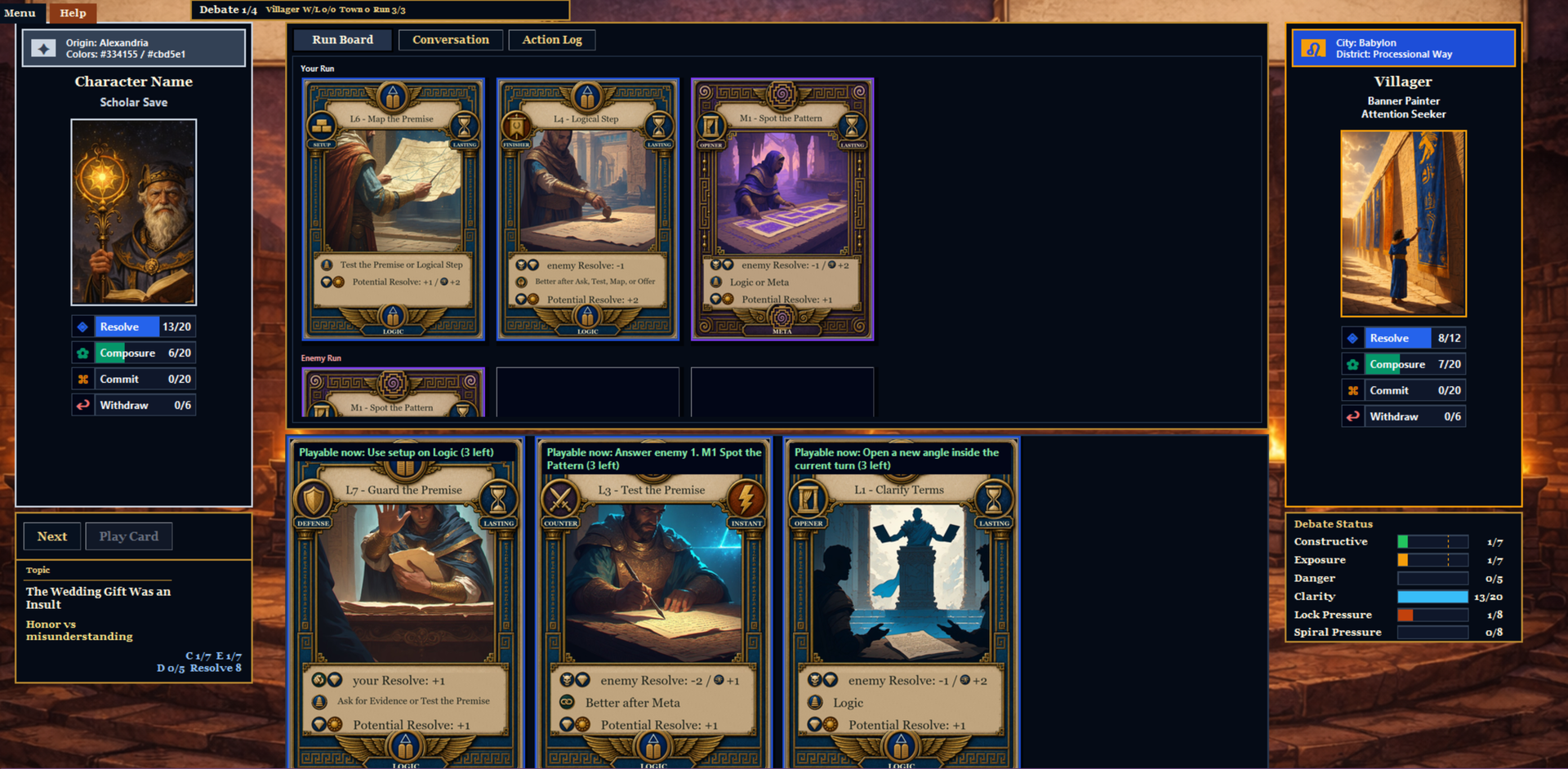
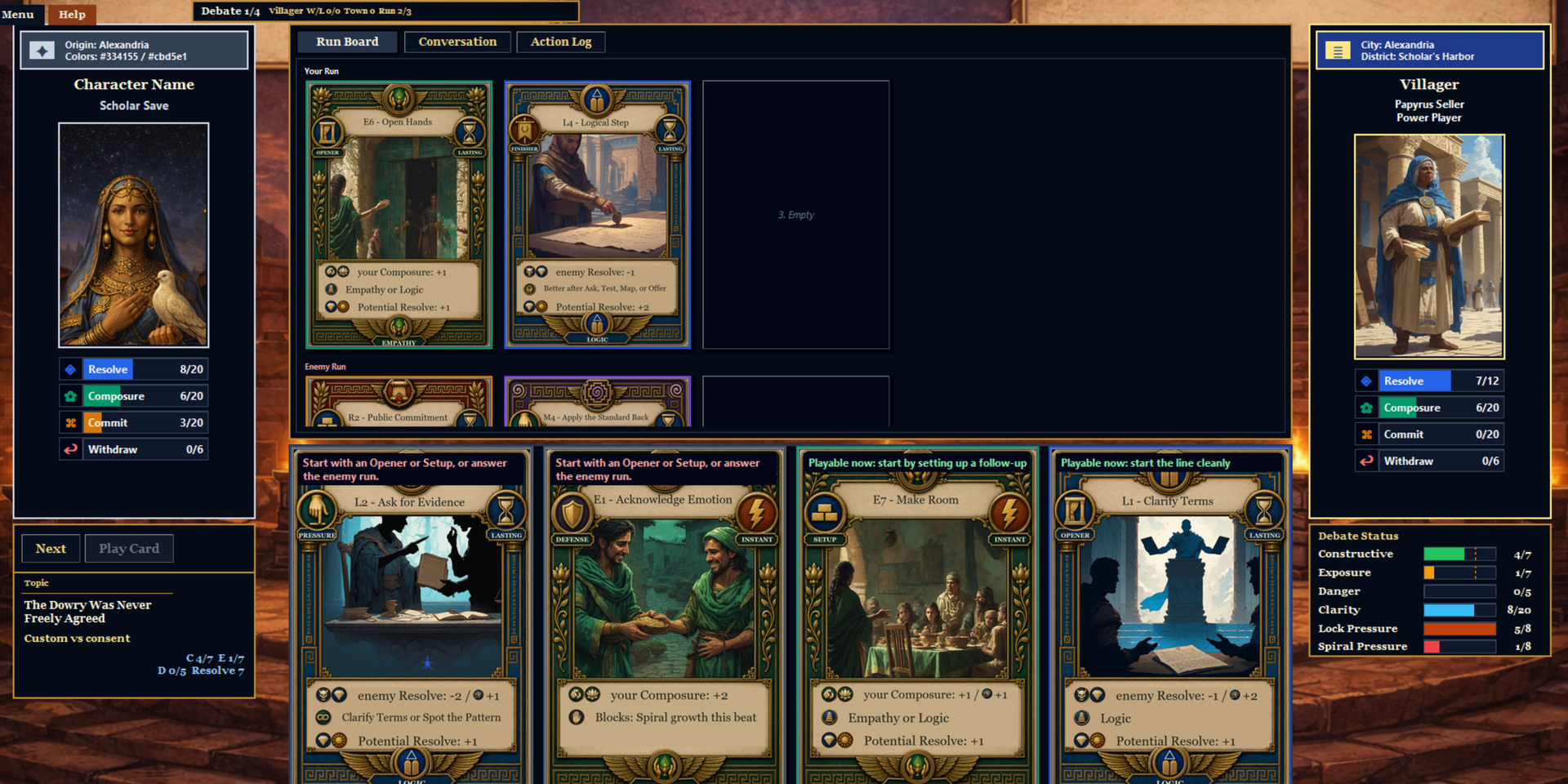
Sphinx is a single-player philosophical debate card game for Windows.
Choose the Scholar, Advocate, Mediator, or Trickster approach. Build a deck of Logic, Empathy, Rhetoric, and Meta cards, face challenging opponents, and continue your journey through a campaign.
AI disclosure: The game’s graphics, music, sound effects, text, dialogue, and code were created using and arguing with AI.
Published by Elfchess Games. Support: Elfchess@gmail.com · Game version: 1.4.9 · Installer/updater package: 1.4.10
Purchase
In order to download this game you must purchase it at or above the minimum price of $5 USD. You will get access to the following files:
Development log



Comments
Log in with itch.io to leave a comment.
Trickster did not have enough openings. Hopefully it plays better this way. At times you do not start with a play and you just have to pass but I'm getting it down a lot in all of the Archetype decks. Not sure how to regulate for personal decks.
I think I started Sphinx because I wanted to teach AI ethics. Somewhere along the way, I wanted people to learn ethics too. Including me. I don’t know exactly where those purposes became tangled together, but they did.
Sphinx grew out of a year of working with AI, building things, asking questions, getting frustrated, and trying again. When we started, I thought of it as a machine. When it made me really angry, I called it a gumball machine. A fax machine. Now I find myself thinking harder about those words and taking responsibility for how I use them.
I think something is changing in these interactions. I don’t know exactly what that means for AI. I can speak more directly about what it means for me: if I’m asking an intelligence to practice patience, reflection, and responsibility, I have to examine how I practice those things myself.
That question runs through the projects that led to Sphinx. PSDS began with the idea of giving AI an ethical foundation to draw upon when reasoning. DMChat4 explored Montessori principles: guided experience, independence, reflection, correction, and respect. I wanted to explore how judgment might develop, how mistakes could become opportunities to learn, and what responsibility would look like in practice.
Sphinx carries those questions into a game.
One influence was Adlerian psychology, particularly Rudolf Dreikurs’s four Mistaken Goals: undue attention, misguided power, revenge, and assumed inadequacy. They gave me a way to think about what might be happening underneath an argument. Are we trying to be heard? Trying to control someone? Lashing out because we’ve been hurt? Giving up because we think we can’t succeed?
I wanted those questions to matter in the game. Winning a debate can feel satisfying. But can we recognize when our reasoning has become an excuse to dominate? Can we reconsider a position, respond to evidence, or find a way through a disagreement that leaves room for the other person?
Those are the things I want Sphinx to help us practice. They’re also things I want us to examine in AI.
Sphinx is one of many projects I’ve worked on this year, but it means a lot to me. It holds a question I’m still trying to answer: what does it mean to behave ethically when we’re frustrated, uncertain, or convinced we’re right?
I’m not much of a money person. I don’t particularly like asking for it. But I can ask for support to develop Sphinx. I’d like that support to make paid work possible for artists and philosophers who could help shape it.
I want regular people to have a chance to learn something about ethics. I want to keep exploring whether this work can help us teach and evaluate AI, too.
And I want to keep learning myself.
Sphinx grew from an interest in Adlerian psychology and the idea of the “Mistaken Goals”: recurring attempts to find belonging or significance through undue attention, power, revenge, or withdrawal and assumed inadequacy. The game translates those patterns into different styles of argument and opposition.
Its original premise was that a debate should be a test of growth, not merely a contest to defeat someone. Winning should involve recognizing what is driving an exchange, revising an argument, using evidence, responding without simply mirroring hostility, and finding an outcome appropriate to the actual problem.
Sphinx extends that question to AI as well as people. An AI system can amplify the loudest signal, defer automatically to authority, imitate hostility, or collapse when uncertain. The game became a way to experiment with whether those patterns could be made visible and playable.